If you spend more than 48 hours in Laos, you will inevitably hear the phrase “Sabai Sabai.” On the surface, it translates to “comfortable,” “well,” or “chilled out.” But look deeper, and you’ll realize it is the invisible glue that holds Lao society together. In a world that seems to be spinning faster every year, Laos—and specifically the Sabai Sabai philosophy—offers a masterclass in emotional intelligence and slow living.
However, for the uninitiated traveler, this laid-back exterior can occasionally lead to “culture shock in slow motion.” To navigate Laos with grace, you need to understand the subtle social dance of respect, “face,” and harmony.
The Philosophy of “Face” and Harmony
In Western cultures, we are often taught that “the squeaky wheel gets the grease.” In Laos, the squeaky wheel is simply seen as broken. The concept of “Face” (equivalent to dignity or social standing) is paramount.
If a bus is two hours late or a restaurant gets your order wrong, raising your voice or showing visible anger doesn’t just make you look rude—it causes the other person to “lose face.” In Lao culture, once face is lost, the social bridge is burnt. The person you are shouting at will likely shut down, stop smiling, and may even walk away to avoid further conflict.
The Golden Rule: If you have a problem, address it with a “Sia Jai” (sorry/sad) smile and a soft tone. You will find that doors open much faster for a traveler who remains Sabai Sabai than one who demands “managerial intervention.”
The Anatomy of the Nop (The Traditional Greeting)
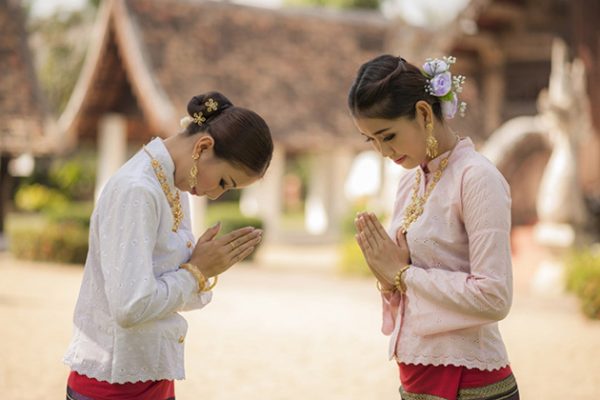
While “Sabaidee” is the universal hello, the Nop is the physical manifestation of your respect. It is a prayer-like gesture with the palms pressed together. But where you place your hands matters:
- Peers and Friends: Hands at chest level.
- Elders or Superiors: Hands at chin/nose level with a slight bow.
- Monks and Royalty: Hands at forehead level with a deeper bow.
As a foreigner, a standard Nop at chest level accompanied by a warm smile is almost always appropriate and deeply appreciated. It signals that you aren’t just a passerby; you are a guest who respects the local soil.
Sacred Space: The “Head and Feet” Rule
Lao culture views the body hierarchically. The head is the most sacred and spiritually “high” part of the person, while the feet are the lowest and most “unclean.”
- Mind Your Feet: Never use your foot to point at an object, a person, or—most importantly—a Buddha statue. When sitting on the floor in a temple or a local home, tuck your feet behind or beside you (the “mermaid” pose) so they aren’t pointing at anyone.
- Respect the Head: Avoid touching anyone on the head, including children. While it might seem like a friendly gesture in the West, in Laos, it can be seen as a spiritual intrusion.
- The “Low” Walk: You may notice Lao people bowing slightly when walking between two people having a conversation. This is a sign of humility, showing they are trying not to “overpower” the space of others.
Dressing for the Occasion
Laos is a modest country. While the heat in 2026 can be intense, the “backpacker uniform” of tiny shorts and tank tops is often viewed as a sign of disrespect, particularly in religious areas.
- Temple Attire: Both men and women should cover their shoulders and knees. In Luang Prabang, many temples require women to wear a Sinh (the traditional wrap-around skirt). You can rent these at the entrance for a few thousand Kip, and it makes for a much more authentic (and respectful) experience.
- Public Decorum: Public displays of affection (heavy kissing or hugging) are generally frowned upon. A gentle hand-hold is fine, but keeping it “PG” is the local standard.
The “Sabai Sabai” Pace: Embracing the Wait
One of the biggest challenges for travelers coming from high-efficiency hubs like Singapore or New York is the pace of service. In a Lao guesthouse or cafe, your coffee might take 15 minutes. Your check might take another 10.
In the Lao mindset, why rush? The sun is shining, the Mekong is flowing, and you have a seat. To get frustrated is to miss the point of being here. When you stop checking your watch and start noticing the details—the way the light hits the Frangipani trees or the sound of the distant temple drums—you have finally arrived in Laos.
Summary Checklist for the Respectful Traveler:
| Situation | The “Lao Way” |
| Entering a Home/Temple | Remove shoes outside. |
| Giving/Receiving | Use both hands or your right hand (never just the left). |
| Meeting a Monk | Keep your head lower than theirs; women should never touch a monk. |
| Drinking | Lao culture is communal. If you’re sharing a Beerlao, expect to pour for others! |
Culture, Laos, Luang Prabang, Monks, Travel

Comments RSS Feed